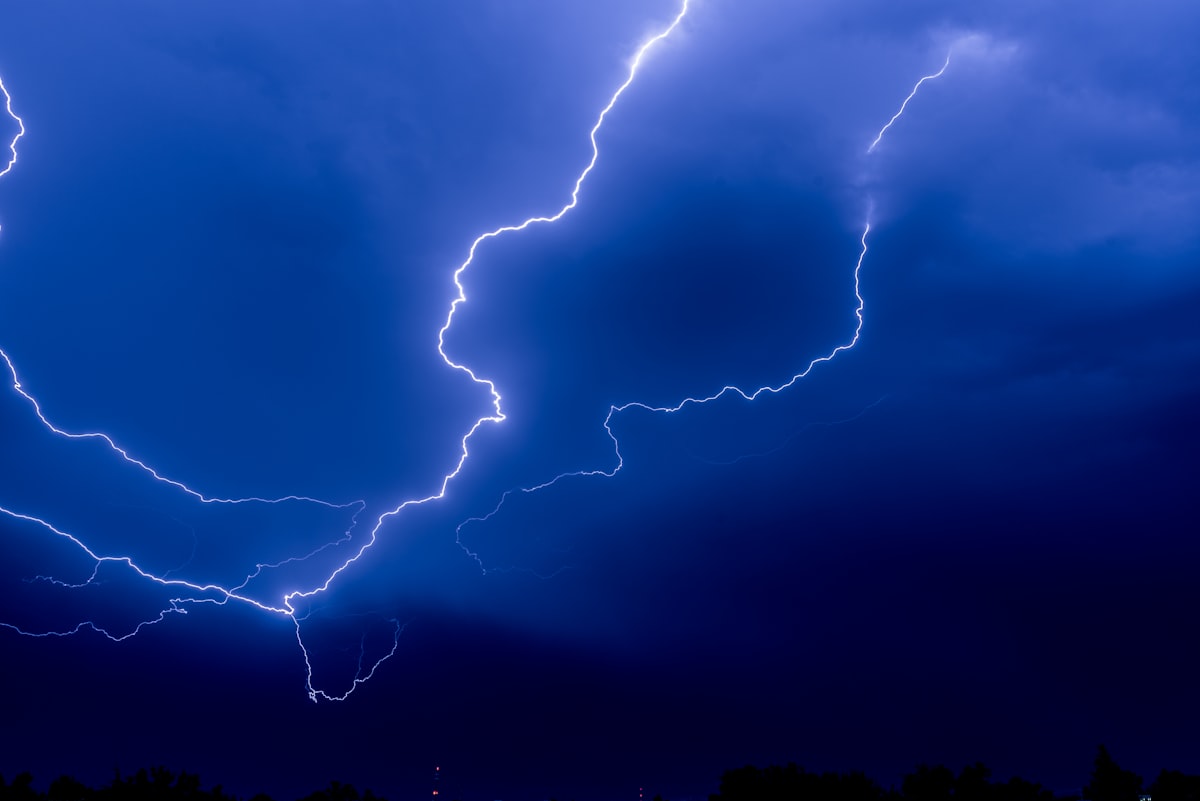
The obvious question about lightning is: why does it take such a roundabout path? Air is a reasonable insulator, but electricity should still want the most direct route between cloud and ground. The path a bolt actually takes rarely looks direct at all — it branches, backtracks, terminates in mid-air. The answer involves a process that happens in the milliseconds before the visible stroke, entirely too fast to see without specialist equipment.
Where the charge comes from
Inside a cumulonimbus cloud, the updraught and the different phase changes of water create a charge distribution that is roughly — and the roughness matters — negative at the base of the cloud and positive near the top. The negative charge at the base induces a corresponding positive charge on the ground directly below, particularly on tall, pointed objects.
The mechanism that creates this charge separation involves the interaction between small ice crystals carried upward in the updraught and larger graupel particles (soft hail) falling through them. The collisions transfer charge: the small crystals typically end up positive, the graupel negative. Separated by the flow of air, the result is an electrical field across the cloud that can reach tens of millions of volts between cloud base and ground.
This is where most descriptions stop. The interesting part is what happens next.
The stepped leader: a process of probing
Lightning does not simply arc from cloud to ground in a single stroke. Before the visible flash, there is a preliminary process called a stepped leader. It is a poorly luminous channel of ionised air that propagates downward from the cloud base in discrete steps — each step around 50 to 100 metres, taking about a microsecond, followed by a pause of roughly 50 microseconds before the next step.
Each step follows the path of least resistance at that moment. It does not plan ahead. It does not calculate the overall optimum path. It advances into the air in a direction that happens to be locally conductive — and air conductivity is highly variable on small scales, depending on humidity, temperature, the presence of ionised molecules from previous near-miss discharges, and other factors that are essentially random from the leader's perspective.
This is why the path branches and why it is not straight. The leader is exploring the local structure of the air, and the air is heterogeneous. Some branches terminate when they reach dead ends — regions where the conductivity drops away before they have connected with the ground. Other branches continue. The jagged shape records the history of those local probing steps.
The return stroke: what you actually see
When the stepped leader comes close enough to the ground — typically within tens of metres — upward streamers from ground objects meet it. The meeting point connects the leader channel to ground, and almost instantly, a massive current flows upward through the completed channel. This is the return stroke.
The return stroke is what you see as the visible lightning flash. It travels at roughly one-third the speed of light. The channel heats to around 30,000 Kelvin — roughly five times the temperature of the surface of the sun — in a fraction of a millisecond. The rapid heating causes explosive expansion of the air, which produces the pressure wave you hear as thunder.
Because the stepped leader has already established the channel, the return stroke follows exactly the jagged path the leader traced. The flash you see is not electricity finding a path — it is electricity taking a path that has already been found, and returning through it.
Why strikes concentrate where they do
The height of an object matters because it shortens the gap the leader needs to cross. A tall tree or tower on a hilltop is not attracting lightning from a great distance — the leader needs to be quite close before the upward streamer can connect with it. But by closing the gap, tall objects make connection substantially more likely once a leader is in the vicinity.
The pointed nature of tall objects also concentrates the electric field, which encourages upward streamers to form. A lightning rod works by providing a conductor path through which the return stroke current can flow to ground without passing through the structure it protects.
Sheet lightning and intra-cloud discharges
Not all lightning reaches the ground. Cloud-to-ground lightning — the type with the dramatic visible bolt — represents less than half of all lightning discharges. Most lightning occurs within the cloud itself or between clouds, illuminating large areas without a visible channel to the ground. This is what is often called sheet lightning, though the term is informal. The physics is essentially the same — stepped leader, return stroke, massive current — but the geometry keeps it entirely within the cloud structure.